

Histones are the main constituents of the protein part of chromosomes of eukaryotic cells. They are rich in the amino acids arginine and lysine and have been greatly conserved during evolution. Histones pack the DNA into tight masses of chromatin. Two core histones of each class H2A, H2B, H3 and H4 assemble and are wrapped by 146 base pairs of DNA to form one octameric nucleosome. Histone tails undergo numerous post-translational modifications, which either directly or indirectly alter chromatin structure to facilitate transcriptional activation or repression or other nuclear processes. In addition to the genetic code, combinations of the different histone modifications reveal the so-called “histone code”. Histone methylation and demethylation is dynamically regulated by respectively histone methyl transferases and histone demethylases.
H3K27ac monoclonal antibody

Monoclonal antibody raised in mouse against histone H3 acetylated at lysine 27 (H3K27ac), using a KLH-conjugated synthetic peptide.
| Lot | 001-16 |
|---|---|
| Concentration | 1.0 µg/µl |
| Species reactivity | Human, Nematodes: positive. Other species: not tested. |
| Type | Monoclonal |
| Purity | Protein A purified |
| Host | Mouse |
| Storage Conditions | Store at -20°C; for long storage, store at -80°C. Avoid multiple freeze-thaw cycles. |
| Storage Buffer | PBS containing 0.05% azide. |
| Precautions | This product is for research use only. Not for use in diagnostic or therapeutic procedures. |
| Applications | Suggested dilution | References |
|---|---|---|
| ChIP/ChIP-seq* | 0.5-1 μg/ChIP | Fig 1, 2 |
| CUT&TAG | 1 μg | Fig 3 |
| ELISA | 1:3,000 | Fig 4 |
| Western Blotting | 1:1,000 - 1:2,000 | |
| Immunofluorescence | 1:500 | Fig 5 |
* Please note that the optimal antibody amount per IP should be determined by the end-user. We recommend testing 0.5-5 µg per IP.
- Validation Data
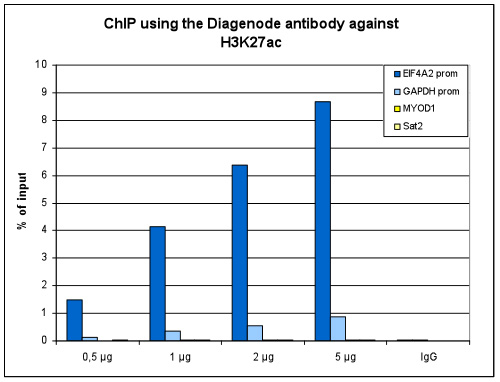
Figure 1. ChIP results obtained with the antibody directed against H3K27ac
ChIP assays were performed using human HeLa cells, the monoclonal antibody against H3K27ac (cat. No. C15200184) and optimized PCR primer pairs for qPCR. ChIP was performed with the “iDeal ChIP-seq” kit (cat. No. C01010051), using sheared chromatin from 1 million cells. A titration consisting of 0.5, 1, 2 and 5 µg of antibody per ChIP experiment was analyzed. IgG (1 µg/IP) was used as a negative IP control. Quantitative PCR was performed with primers specific for the promoters of the EIF4A2 and GAPDH genes, used as positive controls, and for the inactive MYOD1 gene and the Sat2 satellite repeat, used as negative controls. Figure 1 shows the recovery, expressed as a % of input (the relative amount of immunoprecipitated DNA compared to input DNA after qPCR analysis).
Figure 2. ChIP-seq results obtained with the antibody directed against H3K27ac
ChIP was performed on sheared chromatin from 500000 HeLa cells using 1 µg of the monoclonal antibody against H3K27ac (cat. No. C15200184) as described above. Libraries were prepared with the Microplex library preparation kit (cat. No. C05010001) and analysed on an Illumina HiSeq4000. Cluster generation and sequencing were performed according to the manufacturer’s instructions. The 50 bp tags were aligned to the human genome using the BWA algorithm. Figure 2 shows the peak distribution along the complete sequence and a 2 Mb region of chromosome 1 (figure 2A and B) and in two regions surrounding the GAPDH and EIF4A2 positive control genes, respectively (figure 2C and D).A.

Figure 3. Cut&Tag results obtained with the antibody directed against H3K27ac
CUT&TAG was performed on 50,000 K562 cells using 1 µg of the antibody against H3K27ac (cat. No. C15200184) and the iDeal CUT&Tag kit (C01070020). The libraries were subsequently analysed on an Illumina NextSeq 500 sequencer (2x75 paired-end reads) according to the manufacturer’s instructions. The tags were aligned to the human genome (hg19) using the BWA algorithm. Figure 3 shows the peak distribution along the complete sequence of chromosome 7 and in a 250 kb region surrounding the ESWR1 gene on chromosome 12 (figure 3A and B, respectively).
Figure 4. Cross reactivity of the antibody directed against H3K27ac
To test the specificity an ELISA was performed using a serial dilution of the monoclonal antibody against H3K27ac (cat. No. C15410184). The wells were coated with peptides containing the unmodified H3K27 region as well as the acetylated H3K27 and the acetylated H3K9. Figure 4 shows a high specificity of the antibody for the peptide containing the modification of interest.
Figure 5. Immunofluorescence using the antibody directed against H3K27ac
HeLa cells were stained with the monoclonal antibody against H3K27ac (cat. No. C15410184) and with DAPI. Cells were fixed with 4% formaldehyde for 10’ and blocked with PBS/TX-100 containing 5% normal goat serum and 1% BSA. The cells were immunofluorescently labelled with the H3K27ac antibody (left) diluted 1:500 in blocking solution followed by an anti-mouse antibody conjugated to Alexa594. The middle panel shows staining of the nuclei with DAPI. A merge of the two stainings is shown on the right. - 出版物

How to properly cite our product/service in your work
We strongly recommend using this: H3K27ac monoclonal antibody (Hologic Diagenode Cat# C15200184 Lot# 001-16). Click here to copy to clipboard.
Using our products or services in your publication? Let us know!
Systematic discovery and functional dissection of enhancers needed forcancer cell fitness and proliferation.
Chen Poshen B et al.
A scarcity of functionally validated enhancers in the human genome presents a significant hurdle to understanding how these cis-regulatory elements contribute to human diseases. We carry out highly multiplexed CRISPR-based perturbation and sequencing to identify enhancers required for cell proliferation and fitness ...Evidence for long-term association of virion-delivered HBV core proteinwith cccDNA independently of viral protein production
Lucifora Julie et al.
Background \& Aims HBV persists in the nucleus of infected hepatocytes as a covalently closed circular DNA (cccDNA) episome that constitutes the template for viral RNA and protein synthesis. Both HBx and HBc (core) viral proteins associate with cccDNA but, while HBx is required for viral transcription, the role ...Potent and selective bivalent inhibitors of BET bromodomains
Waring M.J. et al.
Proteins of the bromodomain and extraterminal (BET) family, in particular bromodomain-containing protein 4 (BRD4), are of great interest as biological targets. BET proteins contain two separate bromodomains, and existing inhibitors bind to them monovalently. Here we describe the discovery and characterization of pro...Germline organization in Strongyloides nematodes reveals alternative differentiation and regulation mechanisms.
Kulkarni A et al.
Nematodes of the genus Strongyloides are important parasites of vertebrates including man. Currently, little is known about their germline organization or reproductive biology and how this influences their parasitic life strategies. Here, we analyze the structure of the germline in several Strongyloides and closely ...